Safe and Responsible Driving: theory test questions
420 questions from the Irish Driver Theory Test, each with the correct answer and an explanation.
- With regard to vehicle speed, what should a driver do when driving at night?Answer: Drive at a speed that enables the driver to stop within the distance ahead that they can see to be clear.
- What lights should be shown on a parked car, tractor or works vehicle at night on an unlit public road?Answer: At least one side lamp front and rear on the side nearest the centre of the road.
- What should a driver do if they encounter loose chippings on a road?Answer: Slow down and allow extra clearance to other traffic.
- When a driver is making a left-hand turn, what mirrors should they particularly concentrate on?Answer: The interior and left exterior mirror.
- How should a driver manage a steep descent in snow or frosty weather?Answer: Engage a lower gear early and use gentle braking applications to keep the speed down.
- How can a pedestrian walking along a poorly lit road reduce the risk of an accident occurring?Answer: Wear high-visibility clothing.
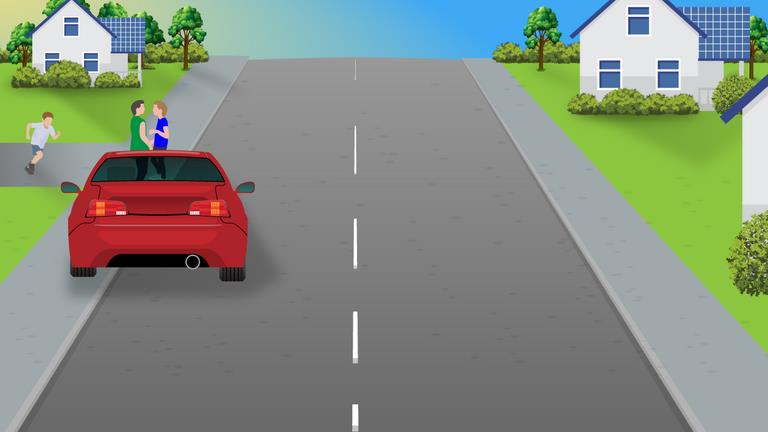
- What should a driver do in this situation?Answer: Reduce speed and be prepared to stop as other children could follow.
- What can be achieved by the driving style known as ‘Eco-Driving’?Answer: Reduced fuel consumption.
- After exiting the motorway and coming towards a junction at the end of the deceleration lane (slip road) what should a driver do?Answer: Be alert for oncoming and crossing traffic at the end of the slip road.
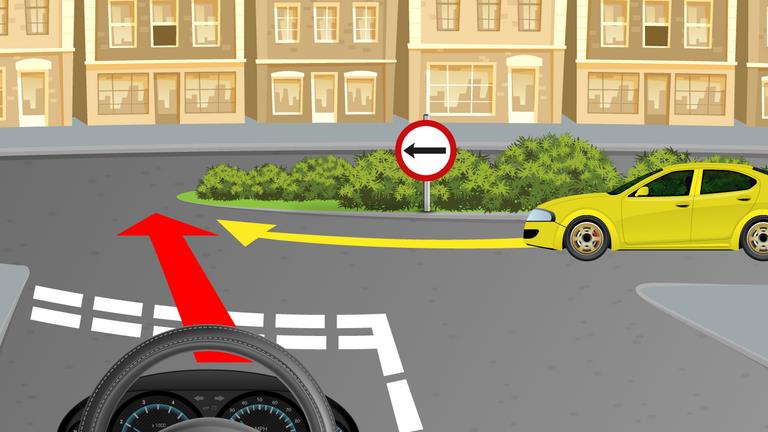
- What should the driver do in this situation?Answer: The driver must yield to the yellow car on the roundabout.
- What should a driver do when they get a puncture while driving?Answer: Stop at a safe place and change the wheel.
- How should a driver react to emergency services vehicles with flashing blue lights and/or sirens on?Answer: Check their mirrors before looking for space to move aside.
- What stopping distance should a driver allow for when driving in snow or icy conditions?Answer: Up to ten times the normal distance.
- What should a driver do when they want to safely change to the lane on the right in which there is other traffic?Answer: Use the mirror, signal and move into the right-hand lane when a suitable gap appears in the traffic in that lane.
- When driving a tractor and trailer, what should the driver do on entering a roundabout to avoid possible roll-over?Answer: Reduce speed.
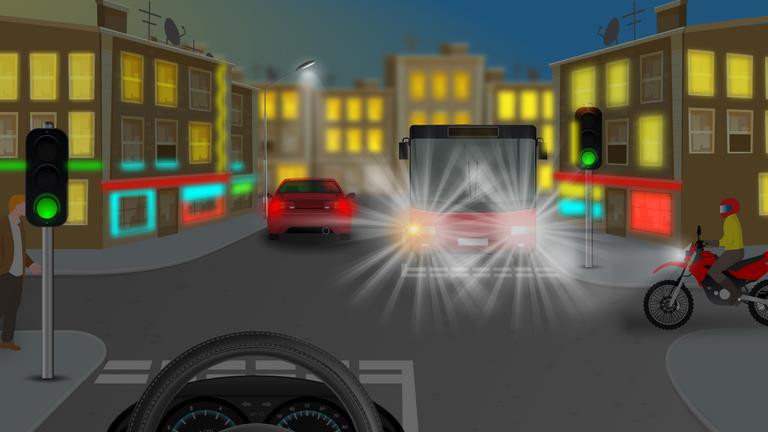
- What should a driver be aware of when driving at night along a shopping street with many different light sources?Answer: Traffic lights may be difficult to distinguish from the other bright lights.
- What is the penalty for a driver who refuses to give breath, blood or urine samples as evidence for a second offence to An Gárda Síochána?Answer: Automatic disqualification for 6 years.
- When driving on dark winter mornings and evenings on unlit country roads, what should a driver be aware of?Answer: Schoolchildren are more vulnerable on unlit country roads on dark winter mornings and evenings.
- When driving late at night what should a driver be aware of?Answer: That there is a danger of themselves or other drivers falling asleep.
- Can a learner driver drive unaccompanied if they are on their third or subsequent learner permit?Answer: No, they cannot drive unaccompanied on any learner permit.
Ready to test yourself?
Answer Safe and Responsible Driving questions one at a time, check each answer, and revisit your mistakes.
Practise this topic