Safe and Responsible Driving: theory test questions
420 questions from the Irish Driver Theory Test, each with the correct answer and an explanation.
- When a vehicle is stopped in a tunnel due to congestion what should a driver do?Answer: Switch off the engine.
- When dazzled by the lights of an oncoming vehicle, what should a driver do?Answer: Do not look directly at the lights.
- When driving along a dual carriageway in normal driving conditions, which lane should a driver be in?Answer: In the left-hand lane unless the driver wishes to overtake or turn right.
- When driving along, a driver feels that the oncoming car may crash into their vehicle. What should they do?Answer: Sound the horn to attract the attention of the other driver and take evasive action.
- When driving at night and blinded by the lights of an oncoming vehicle, what should a driver do?Answer: Look towards the verge and slow down and stop if necessary.
- When driving at night the full headlights of a typical car should enable the driver to see for a distance of how many metres?Answer: 100 metres.
- When driving at night, when must a driver dip the vehicle’s full headlights?Answer: When meeting or driving behind other traffic.
- When driving at night, when must a driver use dipped headlights?Answer: When meeting or driving behind other traffic.
- When can a driver expect to encounter black ice?Answer: When the temperature drops close to freezing.
- When driving along and required to stop suddenly, what should a driver do?Answer: Apply the footbrake firmly.
- When driving at night the dipped headlights of a typical car should enable the driver to see for a distance of how many metres?Answer: 30 metres.
- When driving on dark winter mornings and evenings on unlit country roads, what should a driver be aware of?Answer: That there could be vulnerable pedestrians walking on the road.
- When driving on this one-way street with vehicles parked on both sides, what should a driver be prepared for?Answer: Pedestrians crossing between the vehicles.
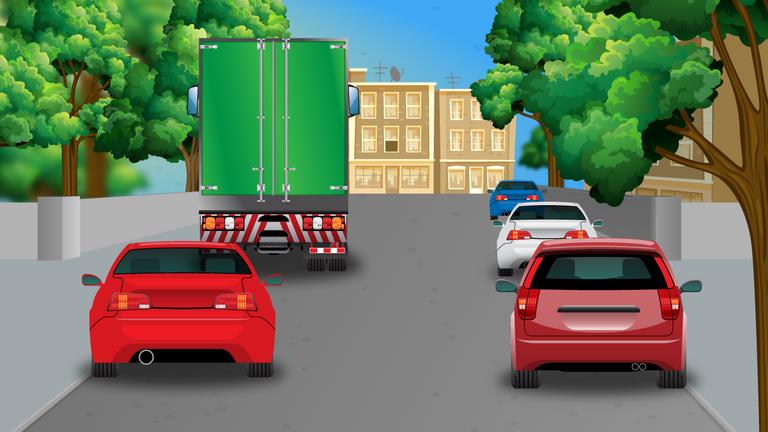
- When driving on a road that has a potholed surface and there is an e-scooter ahead, what should a driver do?Answer: Allow extra clearance in case the e-scooter swerves to avoid a pothole.
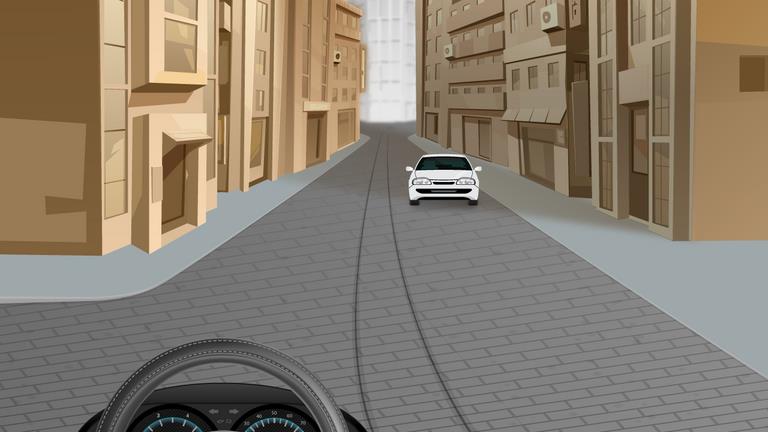
- When driving on a road with tram lines why should a driver take extra care?Answer: Driving on the tracks can reduce tyre grip.
- When driving on dark winter mornings and evenings on unlit country roads, what should a driver be aware of?Answer: Cyclists are much more vulnerable in poor lighting conditions.
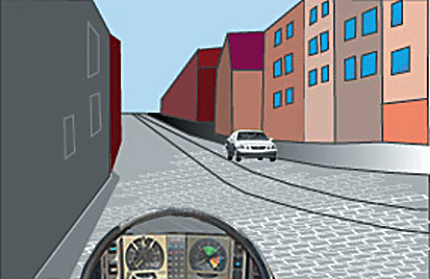
- When driving on a cobblestone road why should you take extra care?Answer: The road surface is uneven and road grip varies.
- When driving on a motorway, what should a driver do if they miss their exit?Answer: Leave the motorway at the next exit and cross to the other side using the fly-over (or underpass).
- When driving on a road that has a potholed surface and there is a cyclist ahead, what should a driver do?Answer: Allow extra clearance in case the cyclist swerves to avoid a pothole.
- When is jack-knifing most likely to occur?Answer: When trying to reduce speed sharply while travelling downhill.
- When is it safe for a driver to use the main beam headlights when driving at night?Answer: When there is no oncoming traffic.
- When is it permissible to overtake another vehicle on the nearside (left-hand side)?Answer: When the vehicle in front is signalling to turn right.
- When meeting an oncoming vehicle at night, what should a driver do?Answer: Avoid looking directly at the oncoming vehicle's lights.
- When is a tractor most likely to overturn?Answer: When turning sharply.
- When must a driver use a red flag as a marker for a rear load overhang that exceeds one metre?Answer: Only during the day.
- When joining a motorway from a slip road, what should a driver do?Answer: Adjust speed to match that of the motorway traffic, and merge into a suitable gap.
- When negotiating junctions, which road users are particularly vulnerable?Answer: Motorcyclists.
- When may the holder of a Category W learner permit carry a passenger on a tractor or works vehicle?Answer: When there is proper passenger seating and the passenger holds a full Category W licence.
- When is a driver allowed to carry more passengers in a car than there are seat belts available?Answer: It is never allowed.
- When should rear fog lights be used?Answer: In dense fog or falling snow.
- When should a driver use fog lights on their vehicle?Answer: Use fog lights only in dense fog and falling snow.
- When should a driver use the vehicle’s rear view mirror?Answer: Before changing direction.
- When required to stop in an emergency, what should a driver do?Answer: Apply the footbrake firmly.
- When stopped at traffic lights, a driver should take particular care for which road users coming up on their left?Answer: Cyclists.
- When stopped at traffic lights and the green light comes on, what should a driver do?Answer: Check that other road users have cleared the junction and move off with care.
- When should rear fog lights be used?Answer: When driving in dense fog or falling snow.
- When should a driver use dipped headlights?Answer: From just after dusk to just before dawn.
- When should pedestrians wear reflective clothing at night?Answer: At night, when walking outside built-up areas.
- When preparing to stop, a driver notices the vehicle behind is towing a trailer. What should the driver do?Answer: Indicate in good time and pull in gradually to allow the vehicle behind extra stopping distance.
- When driving on a national road is it permitted to drive on the hard shoulder in order to allow faster-moving traffic to overtake?Answer: Yes, temporarily when the hard shoulder is clear and it is safe to drive there.
- Which action contributes to Eco-Driving?Answer: Maintaining a steady speed.
- Which type of road users are particularly vulnerable at junctions?Answer: E-scooter users.
- Where may a driver overtake on a 2-plus-1 road?Answer: In the two-lane stretch.
- Which action contributes to Eco-Driving?Answer: Selecting a high gear as soon as possible.
- Which of the following affects the braking distance of a vehicle?Answer: The speed and weight of the vehicle.
- Which of the following road users are most vulnerable in slow-moving city traffic?Answer: Motorcyclists.
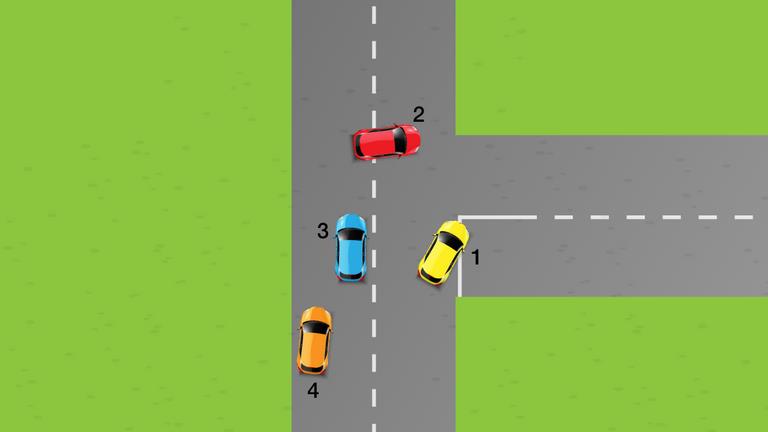
- Which vehicle is in the correct position to make a right turn from the major road into the minor road?Answer: 3
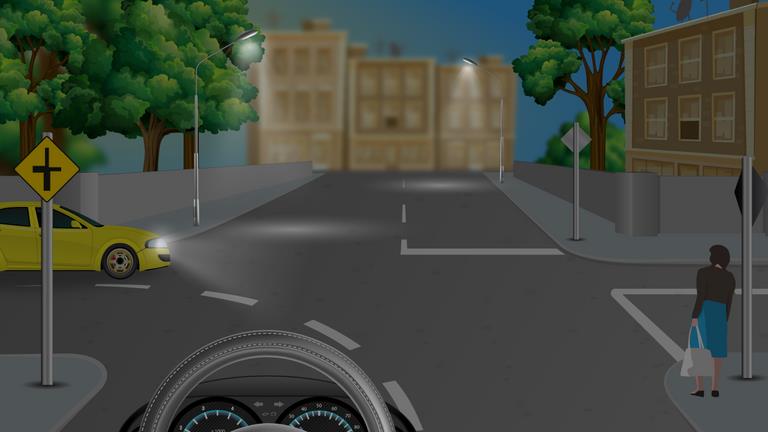
- Why might it be dangerous to drive on a poorly-lit street?Answer: It may be difficult to make out poorly lit vehicles in the dark areas.
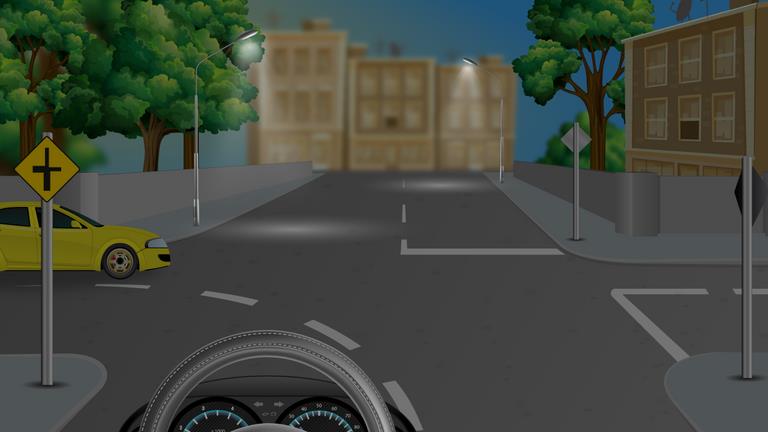
- Why might it be dangerous to drive on a poorly-lit street?Answer: Pedestrians crossing in a dark area might be difficult to see.
- Why is it dangerous to allow children to stand in the space between the front seats of a car?Answer: They could be thrown forward if the brakes are applied suddenly.
Ready to test yourself?
Answer Safe and Responsible Driving questions one at a time, check each answer, and revisit your mistakes.
Practise this topic