Safe and Responsible Driving: theory test questions
420 questions from the Irish Driver Theory Test, each with the correct answer and an explanation.
- On a 2-lane motorway, what procedure should a driver adopt when wishing to overtake another vehicle safely?Answer: Use their mirrors, signal and overtake in the right-hand lane when it is safe to do so.
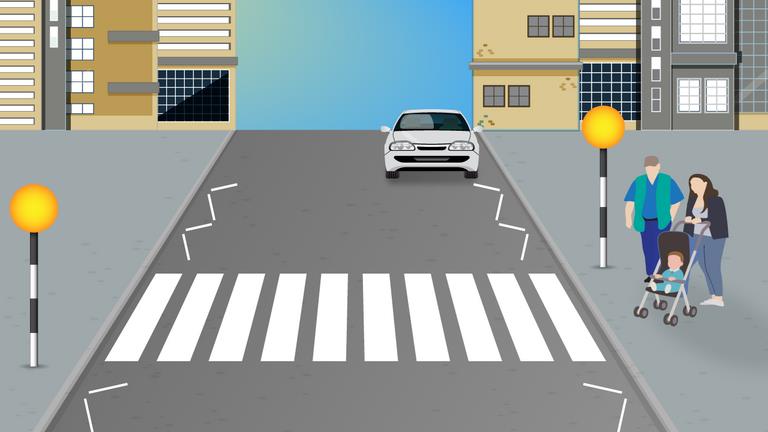
- When approaching the pedestrian crossing, what should the driver do in this situation?Answer: Slow down in good time and be prepared to stop.
- When being overtaken and there is oncoming traffic, what should a driver do?Answer: Allow the overtaking vehicle to pass and return safely to the left side of the road.
- What are the drink driving penalties for a professional driver holding a full car licence and found to have a blood alcohol concentrate (BAC) of 20 mg to 80 mg per 100 millilitres of blood?Answer: €200 fine and 3 months driving disqualification.
- What should a driver do before getting out of the vehicle?Answer: Check their side mirror and look behind before opening the door.
- What should a driver do before turning right from a major road into a minor road?Answer: Yield right of way to oncoming traffic and to pedestrians crossing at the junction.
- At night, what effect could driving with a single headlight have on oncoming drivers?Answer: They could mistake the vehicle for a motorcycle.
- What should a driver do if an ambulance is stopped up ahead with its flashing blue lights on?Answer: Reduce speed and prepare to stop if necessary.
- What should a driver do if dazzled by headlights reflecting in the rear-view mirror of their car?Answer: Use the night driving mode on their rear-view mirror.
- When should a driver move into an auxiliary lane on a motorway?Answer: To leave the motorway.
- What should a driver do when travelling on a motorway or dual carriageway?Answer: Be alert for other drivers who may suddenly change lanes or reduce speed.
- When is it permitted to force oncoming traffic onto the hard shoulder on the opposite side of the road while overtaking?Answer: It is not permitted to force oncoming traffic onto the hard shoulder while overtaking.
- When should a driver use hazard warning lights on a motorway?Answer: When the vehicle has broken down.
- A driver has been driving regularly in daylight and must now undertake a journey at night. What should the driver do?Answer: Drive at a slower speed than in the day as visibility is reduced at night.
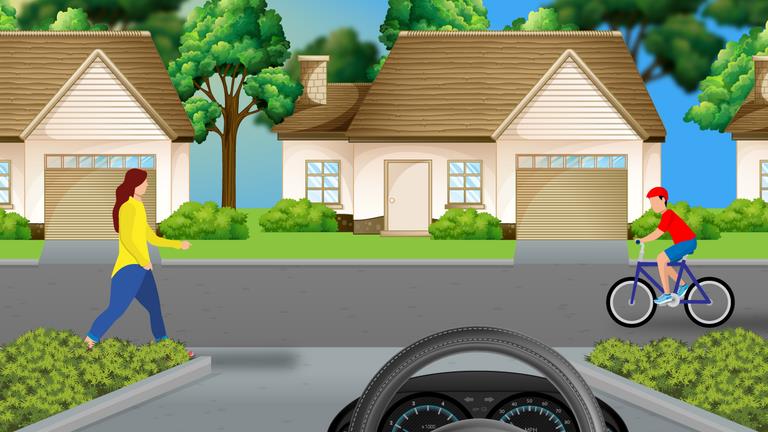
- A driver wants to pull out of a driveway and turn right onto the road. At the same time a cyclist is approaching from the right and a pedestrian wants to cross. Who must wait?Answer: The driver must wait.
- A driver who is about to undertake a journey is upset or angry. What should they do?Answer: A driver should not drive until they are calm.
- A driver approaches a pelican crossing with a flashing amber light showing. There is a pedestrian still on the road. What should the driver do?Answer: Wait and let the pedestrian cross at their own pace.
- A learner driver who has been stopped by a Garda for driving unaccompanied faces a minimum fine of how much?Answer: 160
- Before entering a tunnel, what should a driver do in order to improve vision?Answer: Take off sunglasses.
- What should a driver do if their vehicle gets a puncture on a motorway?Answer: Pull in where safe on the hard shoulder and call for assistance.
- After overtaking another vehicle, what should a driver do?Answer: Gradually move back into the left when the vehicle has been passed.
- Are children allowed to be left unattended in a vehicle?Answer: Children should never be left unattended in a vehicle.
- At road junctions, what type of road users are particularly vulnerable?Answer: Pedestrians.
- Apart from the risk of skidding, what should the driver be aware of when driving in snow?Answer: Road signs and road markings may become obscured.
- Before driving through a tunnel, what should a driver do?Answer: Check that you have enough fuel.
- Are there any occasions when a learner driver can drive unaccompanied?Answer: No, learner drivers must be accompanied at all times by a qualified driver.
- At traffic lights a driver should take particular care for which road users coming up on the left side (nearside)?Answer: Motorcyclists.
- At traffic lights, a driver should take particular care for which road users coming up on the left?Answer: Motorcyclists.
- How does continuous high-speed driving affect fuel consumption?Answer: It increases fuel consumption.
- How does harsh acceleration affect fuel consumption?Answer: Fuel consumption increases.
- During what time periods can a driver be tested for drugs at a road side checkpoint?Answer: Anytime of day or night.
- Do the limits for drink and drug driving differ if detected in the morning?Answer: No, they are the same at all times.
- For how long is a learner driver’s accompanying driver required to have held their full licence in Category B?Answer: 2 years.
- How do you make sure your vehicle is parked safely?Answer: Don't park it where it may endanger other road users.
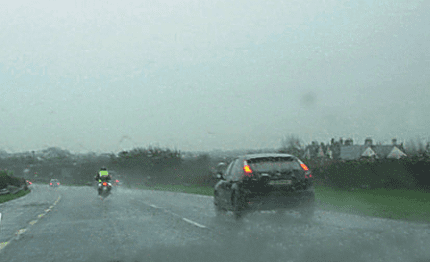
- How does rain affect driving in this situation?Answer: It increases the danger of skidding.
- How are emergency vehicles identified?Answer: By flashing red or blue lights.
- How is a learner driver likely to react in unusual traffic situations?Answer: Slower than an experienced driver.
- Can a person who has passed their car driving test within the last two years act as an accompanying driver?Answer: No, they must hold the full driving licence for a minimum of 2 years.
- How should a driver manage a steep hill or humpbacked bridge when the road is slippery?Answer: Drive with extreme care.
- How should a driver in a vehicle without anti-lock brakes (ABS) deal with a front-wheel straight-line skid?Answer: Press and release the footbrake at rapid intervals.
- How should a driver secure their vehicle before getting out of it?Answer: Apply the parking brake, stop the engine and engage a low gear.
- How would hydraulic power steering be affected if an engine stalled in slow-moving traffic?Answer: The steering would become heavy and difficult to operate.
- If a driver suspects that their vehicle indicators have not been seen, what should the driver do?Answer: Use a clear, decisive hand signal as well.
- If a vehicle being driven through a tunnel goes on fire, what should the driver do?Answer: Leave the vehicle immediately and use the emergency phone at the nearest emergency station.
- If it is safe to overtake a cyclist in speed zones up to 50 km/h, what is the recommended minimum passing distance?Answer: Allow a minimum of 1 metre.
- What should a driver do if their vehicle gets into a four-wheel sideways skid?Answer: Turn the steering wheel in the same direction as the skid and ease off the accelerator.
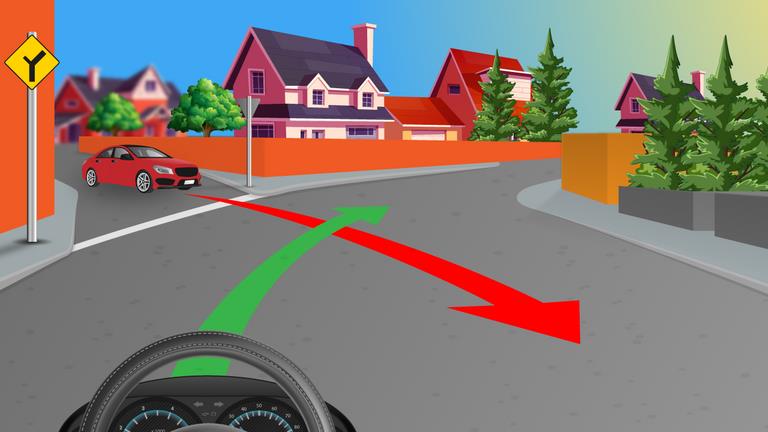
- In this situation, who should wait?Answer: The driver in the red car should wait.
- In wet weather how might a driver judge what is a safe following distance from the vehicle in front?Answer: By allowing at least four seconds to elapse between the vehicle in front and the driver's own vehicle passing a fixed point.
- In general, which of the following should a driver do before entering a tunnel?Answer: Ensure that dipped headlights are switched on.
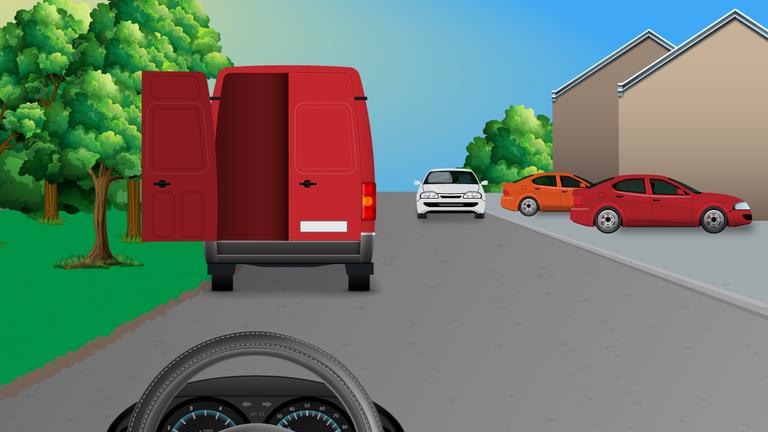
- In this situation who should wait?Answer: The driver behind the stopped van should wait.
Ready to test yourself?
Answer Safe and Responsible Driving questions one at a time, check each answer, and revisit your mistakes.
Practise this topic